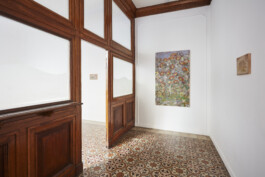
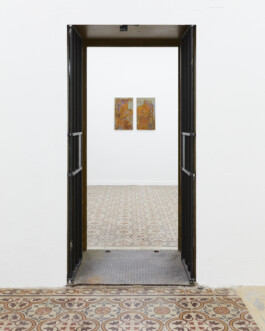
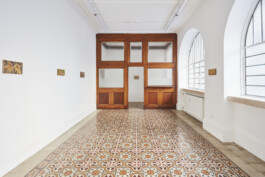
The Address is pleased to present 'Spegnigiorno', the first solo exhibition by Paolo Pretolani at the gallery. The series of previously unseen paintings originates from an extended period of work carried out between his Venice studio and the residency in Brescia. The gallery’s entrance, marked by mural frescoes, provides a unique architectural and atmospheric framework that intertwines with the artist’s investigation, focused on the constant interplay among symbol‑image, materiality and visual memory.
Paolo Pretolani, born in Assisi and raised between Perugia and Venice, forged his artistic formation in proximity to the masters of the Duecento, Trecento, and the Italian Renaissance. Churches, sacred sites, basilicas have always served him as inexhaustible reservoirs of richly symbolic imagery; spaces where he could study not only the construction techniques of frescoes or mural painting, but above all their fragile, perishable condition, vulnerable to erosion, decay, disappearance.
...
This direct observation has become a methodological starting point: Pretolani develops a painting practice that engages with disappearance, with a figuration that is partial, elusive, immersed in an apparent state of abandonment—almost archaeological. Yet his work departs from nostalgia or restorationism: it does not evocate an idealized past, nor does it present historically recognizable icons, but moves in a realm where time becomes an active agent, a pictorial stratum in its own right, capable of deforming, transfiguring, and abstracting original forms.
For Pretolani, painting begins with the choice of material, and even in the earliest interventions: layers, impastos, textures, formal decisions of significant pictorial weight are set in motion. He avoids industrial supports, favoring materials such as wooden panels, cotton, linen, and jute canvas, manually prepared with volcanic stone‑powder (pumice), a technique derived from eighteenth‑century mural tradition, intended to produce surfaces that are light, absorbent, porous. The matter breathes, reveals traces, accepts gesture, generates unexpected chance. Color fields are never uniform: each canvas is constructed through overlaps, veils, erasures, and stratifications that render the surface unstable, alive, sensitive. In this context, the image often appears as a byproduct of the material; a secondary apparition, never defined in advance. As the artist himself indicates, his primary interest at the outset is to produce matter, not image, and when the image does arise, it does so as a phenomenal consequence of the painting’s physical conditions.
Thus, his work cannot be described as figurative in the traditional sense, but rather as material abstraction, in which even recognizable elements such as a flower, an animal, a fossil skull, a technological object lose symbolic strength and become transient presences, fragments of an ongoing process.
One of the central conceptual dimensions of his practice is without doubt time.
Not only understood as the duration of pictorial execution, but as an aesthetic condition, a variable capable of determining appearance, understanding, and survival of the image. The paintings are spaces traversed by time, and what manifests on the painted surface is the result of an unstable equilibrium between what remains and what vanishes. Images do not submit themselves to immediate reading; layered, partial, sometimes erased, they demand prolonged observation, patience, a willingness to confront indeterminacy. As in hypnagogic phenomena or peripheral vision, the apparition occurs only under suspended, slow, non‑assertive observation.
The works on show do not aspire to formal originality, but to a state of uncertain origin. The images belong to no fixed era, neither past nor future: they seem drawn from a time without time. These images could have always existed, or perhaps never existed at all. Thus, they are not “original,” but “originary”: derived from primal forms, archetypal or fossil elements, retaining a character that is potential, unfinished, fluctuating. Figures emerge like fragments of frescoes torn from forgotten walls: camellias, fish floating belly‑up, raptor talons, drones that resemble crabs, candelabrum‑like antennae…
Not icons, but shapes oscillating between mythology and entomology, religion and zoology, relic and invention. The subjects appear like X-rays, blurred effigies, or fossilized presences of a vanished world. These images may be termed spectral, not in the gothic or literary sense, but in optical and phenomenological terms. The spectrum is what no longer is, yet continues to appear. The figures drift in this threshold, suspended between a past that can no longer speak and a future not yet realized. In this liminal zone, doubt is essential: not knowing with certainty what one sees is integral to the aesthetic experience. There is a tragic sweetness in all of this: a dissolution that does not erase, but conceals.
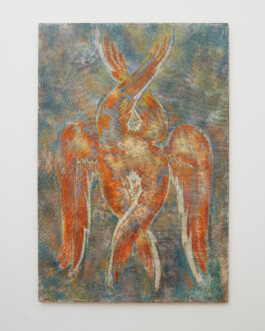
The exhibition’s path concludes with “The Restless,” a figure that synthesizes many tensions of the entire cycle: an angel, or better, a celestial chimera, headless, with six limbs, floating in an apocalyptic sky. It is the only subject clearly -fantastic-, and at once the most real: a body that appears beyond death, beyond time, beyond form.
The title “Spegnigiorno” alludes to a transition between light and shadow, but also to a time that fades without fulfilling itself, like a frozen twilight. It is a compound word, lacking fixed meaning, that coheres with a painting practice in which dissolution assumes greater significance than emergence, and where clarity yields to a nuanced, uncertain understanding, as though every image emerges from opaque matter suffused with soft, diffused light that dissolves contrasts and holds the gaze in a zone of ambiguity.
As at Pompeii or on the island of Thera, where ashes did not destroy but preserved, suspending time in a fragile eternity, so in this cycle the light does not reveal but seeps, and the forms emerge only partially, like relics resurfaced from an interrupted world.
Like an Etruscan fresco or a Byzantine icon corroded by time, each work becomes a fragment of a silent cosmology where the human is but echo, a shadow observing from afar. If painting remains possible, it is because it can speak with a spectral voice, with funereal grace, with the delicacy of a powdered veil that protects what time has not yet dissolved.

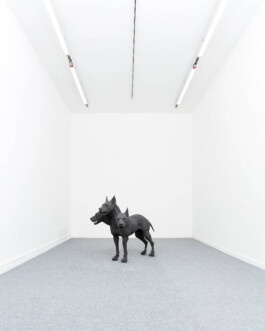
'Spegnigiorno', Installation view, 2025
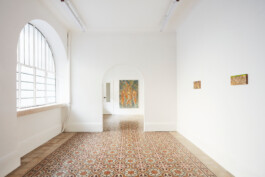
'Spegnigiorno', Installation view, 2025
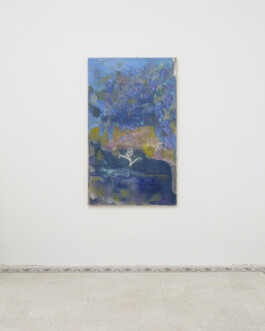
'Spegnigiorno'
2025
Polymaterial painting on jute
152 x 91 cm
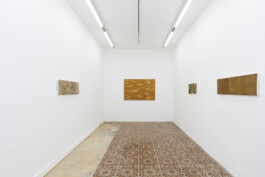
'Spegnigiorno', Installation view, 2025
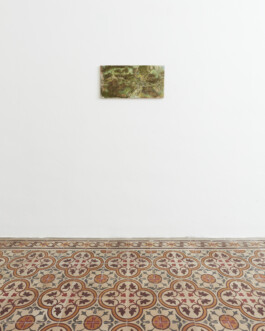
'Promenade'
2025
Polymaterial painting on jute
30 x 60 cm
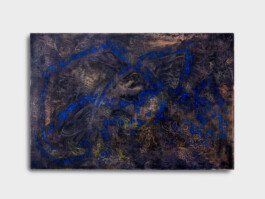
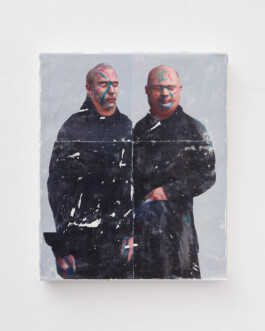
'After Ligabue'
2021
Oil on linen
80 x 120 cm
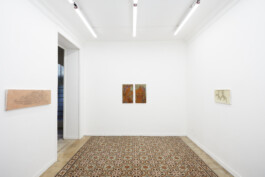
'Spegnigiorno', Installation view, 2025
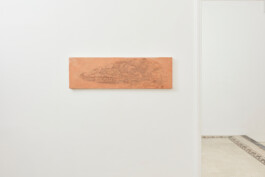
'Spegnigiorno', Installation view, 2025
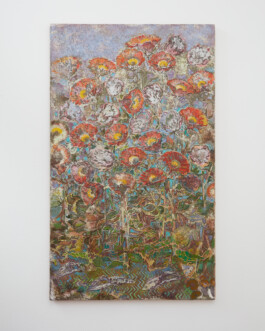
'The restless'
2025
Polymaterial painting on jute
175 x 120 cm
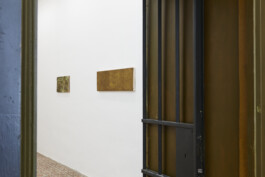
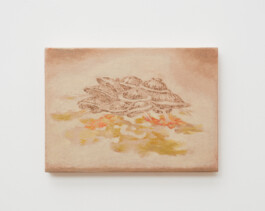
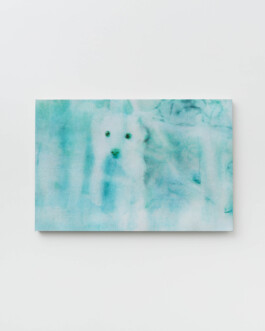
'Flying saucers'
2024
Oil on board
21,5 x 30 cm
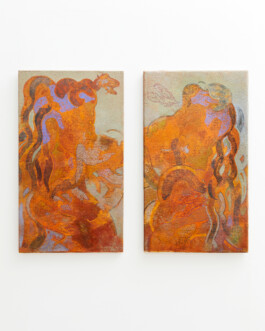
Snake eaters
2025
Polymaterial painting on cotton
70x40 cm each
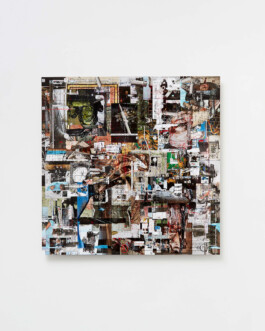
We are no longer at the center of the world. The modern fiction of the human—autonomous, rational, sovereign—has irreversibly shattered. In its place, a new ontology is emerging: distributed, entangled, mechanical. The Anthropocene, with its planetary crises and accelerating techno-scientific shifts, has destabilized the idea of a discrete human subject. Today, we inhabit a post-human condition shaped as much by algorithms and networks as by memory and flesh.
As Rosi Braidotti argues, the post-human does not aim to erase or transcend the human, but to decenter it. The figure of Man—universalized, white, male, colonial—has dominated Western thought for centuries. But this figure was always a fiction, one that excluded, marginalized, and silenced. To move beyond it is to embrace hybridity, nonlinear forms of existence, and modes of subjectivity mediated by technology.
In her ‘Cyborg Manifesto’, Donna Haraway invites us to imagine a future where boundaries are porous—between human and machine, nature and culture, self and network. The artist, in this landscape, is not an isolated genius but a cyborg-body, a node within an extended ecology of code, matter, archives, and algorithms.
This direct observation has become a methodological starting point: Pretolani develops a painting practice that engages with disappearance, with a figuration that is partial, elusive, immersed in an apparent state of abandonment—almost archaeological. Yet his work departs from nostalgia or restorationism: it does not evocate an idealized past, nor does it present historically recognizable icons, but moves in a realm where time becomes an active agent, a pictorial stratum in its own right, capable of deforming, transfiguring, and abstracting original forms.
For Pretolani, painting begins with the choice of material, and even in the earliest interventions: layers, impastos, textures, formal decisions of significant pictorial weight are set in motion. He avoids industrial supports, favoring materials such as wooden panels, cotton, linen, and jute canvas, manually prepared with volcanic stone‑powder (pumice), a technique derived from eighteenth‑century mural tradition, intended to produce surfaces that are light, absorbent, porous. The matter breathes, reveals traces, accepts gesture, generates unexpected chance. Color fields are never uniform: each canvas is constructed through overlaps, veils, erasures, and stratifications that render the surface unstable, alive, sensitive. In this context, the image often appears as a byproduct of the material; a secondary apparition, never defined in advance. As the artist himself indicates, his primary interest at the outset is to produce matter, not image, and when the image does arise, it does so as a phenomenal consequence of the painting’s physical conditions.
Thus, his work cannot be described as figurative in the traditional sense, but rather as material abstraction, in which even recognizable elements such as a flower, an animal, a fossil skull, a technological object lose symbolic strength and become transient presences, fragments of an ongoing process.
One of the central conceptual dimensions of his practice is without doubt time.
Not only understood as the duration of pictorial execution, but as an aesthetic condition, a variable capable of determining appearance, understanding, and survival of the image. The paintings are spaces traversed by time, and what manifests on the painted surface is the result of an unstable equilibrium between what remains and what vanishes. Images do not submit themselves to immediate reading; layered, partial, sometimes erased, they demand prolonged observation, patience, a willingness to confront indeterminacy. As in hypnagogic phenomena or peripheral vision, the apparition occurs only under suspended, slow, non‑assertive observation.
The works on show do not aspire to formal originality, but to a state of uncertain origin. The images belong to no fixed era, neither past nor future: they seem drawn from a time without time. These images could have always existed, or perhaps never existed at all. Thus, they are not “original,” but “originary”: derived from primal forms, archetypal or fossil elements, retaining a character that is potential, unfinished, fluctuating. Figures emerge like fragments of frescoes torn from forgotten walls: camellias, fish floating belly‑up, raptor talons, drones that resemble crabs, candelabrum‑like antennae…
Not icons, but shapes oscillating between mythology and entomology, religion and zoology, relic and invention. The subjects appear like X-rays, blurred effigies, or fossilized presences of a vanished world. These images may be termed spectral, not in the gothic or literary sense, but in optical and phenomenological terms. The spectrum is what no longer is, yet continues to appear. The figures drift in this threshold, suspended between a past that can no longer speak and a future not yet realized. In this liminal zone, doubt is essential: not knowing with certainty what one sees is integral to the aesthetic experience. There is a tragic sweetness in all of this: a dissolution that does not erase, but conceals.
The exhibition’s path concludes with “The Restless,” a figure that synthesizes many tensions of the entire cycle: an angel, or better, a celestial chimera, headless, with six limbs, floating in an apocalyptic sky. It is the only subject clearly -fantastic-, and at once the most real: a body that appears beyond death, beyond time, beyond form.
The title “Spegnigiorno” alludes to a transition between light and shadow, but also to a time that fades without fulfilling itself, like a frozen twilight. It is a compound word, lacking fixed meaning, that coheres with a painting practice in which dissolution assumes greater significance than emergence, and where clarity yields to a nuanced, uncertain understanding, as though every image emerges from opaque matter suffused with soft, diffused light that dissolves contrasts and holds the gaze in a zone of ambiguity.
As at Pompeii or on the island of Thera, where ashes did not destroy but preserved, suspending time in a fragile eternity, so in this cycle the light does not reveal but seeps, and the forms emerge only partially, like relics resurfaced from an interrupted world.
Like an Etruscan fresco or a Byzantine icon corroded by time, each work becomes a fragment of a silent cosmology where the human is but echo, a shadow observing from afar. If painting remains possible, it is because it can speak with a spectral voice, with funereal grace, with the delicacy of a powdered veil that protects what time has not yet dissolved.

'Spegnigiorno'
2025
Polymaterial painting on jute
152 x 91 cm
‘One thousand biceps brachii contractions,
under the guidance of ten soaring phalanxes’
2025
Gesso, marble dust, pigments, acrylic, linseed oil on canvas
204 x 173 cm

‘What remains of me? The imperfect body that is converted
into the first matter, a single gaze staring at nothing’
2024
Gesso, marble dust, pigments, acrylic, linseed oil on canvas
202 x 175 cm
‘In the axis of a total dance, the vivid water where the thirsty
comes to drink ’
2024
Gesso, marble dust, pigments, acrylic, linseed oil on canvas
199 x 170 cm

‘The eyes of the celestial body are white with black pupils,
like those of the two figures it overhangs in the purified land’
2024
Gesso, marble dust, pigments, acrylic, linseed oil on canvas
190 x 173 cm

‘They cannot be transmuted unless they are reduced into
their first matter, and then they are transmuted into another
form than that which they had before’
2025
Gesso, marble dust, pigments, acrylic, linseed oil on canvas
201 x 174 cm
‘You will cross the river of demented impulses, and once purified,
reach the region where everything grows effortlessly’
2025
Gesso, marble dust, pigments, acrylic, linseed oil on canvas
198 x 173 cm
‘But the one who becomes entirely pure and concave,
who allows her entrance, will begin to dance with her and to
say what she says and to dissolve within the ardent jewel
of her presence’
2024
Gesso, marble dust, pigments, acrylic, linseed oil on canvas
197 x 173 cm

‘I am the messenger of the permanent impermanence,
and at the same time I am the resonance of the first shout’
2024
Gesso, marble dust, pigments, acrylic, linseed oil on canvas
198 x 174 cm
The Address
Via Felice Cavallotti 5
25121, Brescia
info@theaddressgallery.com
Wed – Sat, 15-19
or by appointment
+39 3336800755
Privacy Policy
Cookie Policy
Gallery
Via Felice Cavallotti 5, Brescia
Info@theaddressgallery.com
+39 333 680 0755
Opening Hours
Wed – Sat, 15-19